
What’s the Difference?
If you have spent any time looking at cyber security services, there is a good chance you have asked the question:
“What is the difference between penetration testing and vulnerability scanning?”
It is a fair question and, honestly, one we hear quite a lot.
At face value, both services seem to do something similar. They identify weaknesses, talk about vulnerabilities, and produce findings that need fixing. Because of that, many organisations assume they are interchangeable or that one can replace the other.
The reality is they are designed to solve different problems.
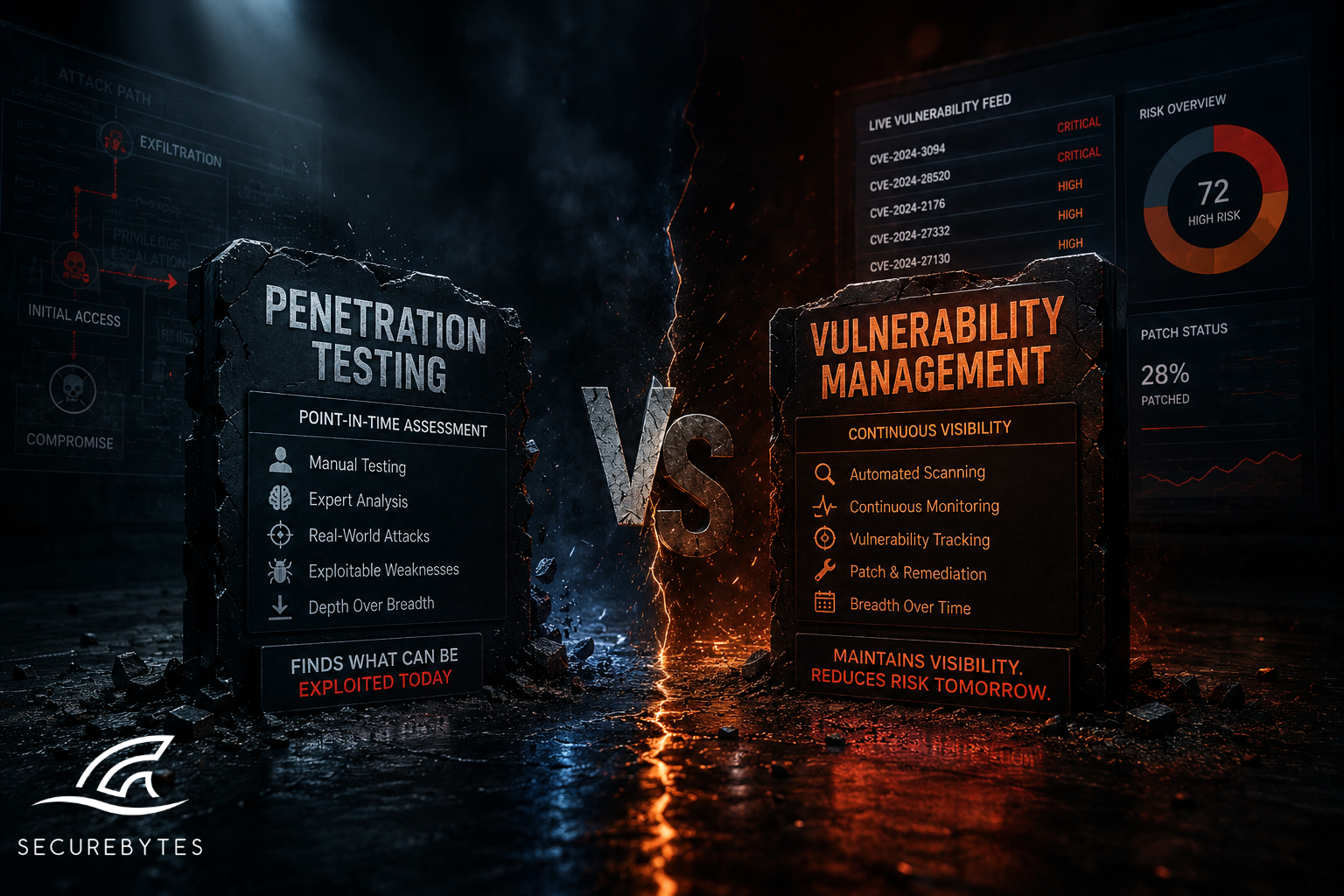
A vulnerability scan helps identify known weaknesses within your environment and maintain visibility over time. A penetration test goes further, assessing what can realistically be exploited and the impact that exploitation may have on your organisation.
The important thing to understand is this:
They are not the same thing, and for most organisations the answer is not choosing one or the other, it is understanding how they work together.
The Car Analogy (Yes, I Use This on Client Calls)
On client calls, I often explain the difference using a car analogy because, surprisingly, it works quite well.
A penetration test is a bit like an MOT. It provides an expert assessment at a specific point in time, identifies issues, and gives you confidence about the state of things at that moment.
However, anyone who drives knows that passing an MOT does not guarantee a trouble-free year.
Having experienced my fair share of inconvenient breakdowns over the years, I can say from experience that warning lights have an annoying habit of appearing at the worst possible time. Tyres wear down, batteries fail, strange noises suddenly appear, and things that seemed perfectly fine a month ago stop behaving quite so perfectly.

If a warning light appeared on the dashboard, most of us would not ignore it until next year’s MOT and simply hope for the best.
Cyber security works much the same way.
A penetration test provides assurance at a specific point in time, but systems change constantly. New software gets installed, updates get missed, devices drift from their intended configuration, and new vulnerabilities are disclosed every day. That is where vulnerability scanning becomes important, it provides visibility between assessments and helps identify issues before they quietly become bigger problems.
What Is Vulnerability Scanning?
Vulnerability scanning is the process of continuously or periodically checking systems, endpoints, servers, infrastructure, and applications for known security weaknesses.
In simple terms, it answers the question:
“What known risks exist in my environment today?”
A vulnerability scanning service identifies issues such as missing security updates, unsupported software, insecure configurations, outdated applications, and known vulnerabilities that attackers may already be actively targeting.
Unlike penetration testing, vulnerability scanning is not normally a once-a-year activity. It is designed to provide ongoing visibility. Depending on organisational requirements, scans may run weekly, monthly, or even more frequently to help security teams stay ahead of emerging issues.
This matters because environments change quickly.
A laptop gets deployed without all updates installed. A server misses patches following a reboot problem. Someone installs software three years ago that nobody remembers exists until it suddenly becomes vulnerable.
Attackers are not waiting for your next penetration test.
They scan continuously.
Defenders should be doing something similar.
The Patching Problem Nobody Talks About Enough
One of the biggest misconceptions we encounter is organisations believing they are fully patched because Windows Update reports that everything is up to date.
Unfortunately, it is often not quite that simple.
For example, many organisations overlook the Windows Update setting:
“Receive updates for other Microsoft products”
When disabled, systems may miss important updates relating to products such as Microsoft Office, SQL components, .NET frameworks, Edge, development tools, and other Microsoft software that may have been installed over time.
Then there is third-party software, arguably one of the most overlooked security issues we see.
PDF readers, remote support tools, conferencing software, VPN clients, utilities, browsers, browser extensions and countless applications installed years ago often sit quietly in the background, forgotten.
Attackers tend not to forget about them.
Vulnerability scanning helps organisations identify these blind spots quickly and consistently, rather than discovering them during a security incident or next year’s assessment.
Why Vulnerability Scanning Is Becoming More Important for Cyber Essentials
The 2026 Cyber Essentials changes have placed even greater emphasis on vulnerability remediation and patching.
In practical terms, organisations are expected to maintain supported software, remediate vulnerabilities quickly, and ensure systems remain securely updated over time.
That means patching is no longer simply a “good thing to do”.
It is increasingly important from a compliance perspective.
Passing a Cyber Essentials or Cyber Essentials Plus assessment is valuable, but organisations also need to remain secure and compliant between assessments. This is one of the reasons vulnerability scanning has become increasingly important, it provides visibility into patching gaps, missing updates, unsupported software and emerging vulnerabilities before they become a bigger problem.
What Is Penetration Testing?
Penetration testing takes a very different approach.
Rather than simply identifying known weaknesses, a penetration test attempts to determine what can realistically be exploited and what the real-world impact might be.
In simple terms, it answers this question:
“If an attacker targeted us, what could they actually do?”
A penetration test is expert-led and manual by design.
Rather than simply producing a list of missing patches or configuration issues, a penetration tester analyses attack paths, validates findings, chains weaknesses together, and looks at security from an attacker’s perspective.
For example, a vulnerability scanner may identify a missing patch on an externally facing server.
A penetration tester may demonstrate how that weakness could be combined with weak permissions, insecure configuration, poor segmentation or credential exposure to gain broader access into the environment.
That distinction matters.
Not every vulnerability represents meaningful business risk, and not every vulnerability is realistically exploitable.
Equally, some weaknesses that appear minor in isolation can become serious when combined together.
Human expertise matters because attackers do not think in individual vulnerabilities, they think in opportunities.
So, Which One Do You Need?
The honest answer for most organisations?
Both.
If you only carry out vulnerability scanning, you gain visibility of known issues but may struggle to understand exploitability, real-world impact, or where risk should truly be prioritised.
If you only perform annual penetration testing, new vulnerabilities can emerge months later without visibility, particularly as systems change and new threats appear.
A mature approach to cyber security treats the two services as complementary.
Penetration testing helps validate real-world security and identify exploitable weaknesses.
Vulnerability scanning helps maintain visibility between assessments and ensures emerging risks do not quietly go unnoticed.
One provides depth.
The other provides continuity.
Together, they give organisations a significantly stronger understanding of their security posture.
Final Thoughts
If penetration testing is the annual MOT, vulnerability scanning is the dashboard warning light.
Neither replaces the other.
Both serve different purposes.
And both become significantly more valuable when used together.
Cyber security should not be viewed as a once-a-year exercise. Threats evolve, software changes, vulnerabilities emerge, and environments rarely stay still for long.
The goal is not simply to pass an assessment, tick a compliance box, or receive a report that gathers dust.
The goal is to reduce risk, maintain visibility, and avoid unpleasant surprises.
If you would like to better understand the difference between penetration testing and vulnerability scanning, or discuss how Securebytes can help support both, speak to the team. We are always happy to have a practical, jargon-free conversation about improving security without unnecessary complexity.